Wolf repair
Wall ovens · single, double, convection
Wolf wall oven repair, one cavity at a time
A failing oven seldom quits overnight. It warns you through the food first: a crust that browns on one side only, cookies that need an extra eight minutes, a roast that is still pink after the timer. Northland Kitchen Service repairs Wolf built-in wall ovens throughout the North Shore of Chicago, and we read those clues the way a baker would before we ever pull a panel. You can reach us 24/7, with technicians out every day, 8 AM to 6 PM.
Two cavities, two separate diagnoses
A Wolf double oven looks like one appliance, but electrically it behaves like two. The upper and lower cavities each carry their own heating elements, its own temperature sensor and, on convection models, its own fan. So when the upper oven bakes perfectly and the lower one runs cool, that is not a contradiction. It simply tells us the fault is local to one cavity, and we test that cavity on its own rather than assuming a shared part has gone.
The same logic helps on a single oven. Bake, broil and convection use different combinations of elements and the fan. If broiling works but baking does not, the broil element and the controls are probably fine, and attention goes to the bake element and its wiring. That kind of narrowing is why we ask what the oven still does well, not only what it has stopped doing.
Before the visit, it helps to know whether you have a single, a double or a convection steam model. Steam ovens have a water system and their own set of failures, covered on the steam oven page. For a range with an oven underneath, see range repair instead.
Short answerWolf wall oven not heating — what is usually wrong?
A Wolf wall oven that lights up yet stays cold most often has an open bake element, a faulty temperature probe, a stuck relay on its board, or simply a tripped breaker. Check the breaker first. If the display works and the oven still will not heat, a technician tests the element, sensor and board in that order.
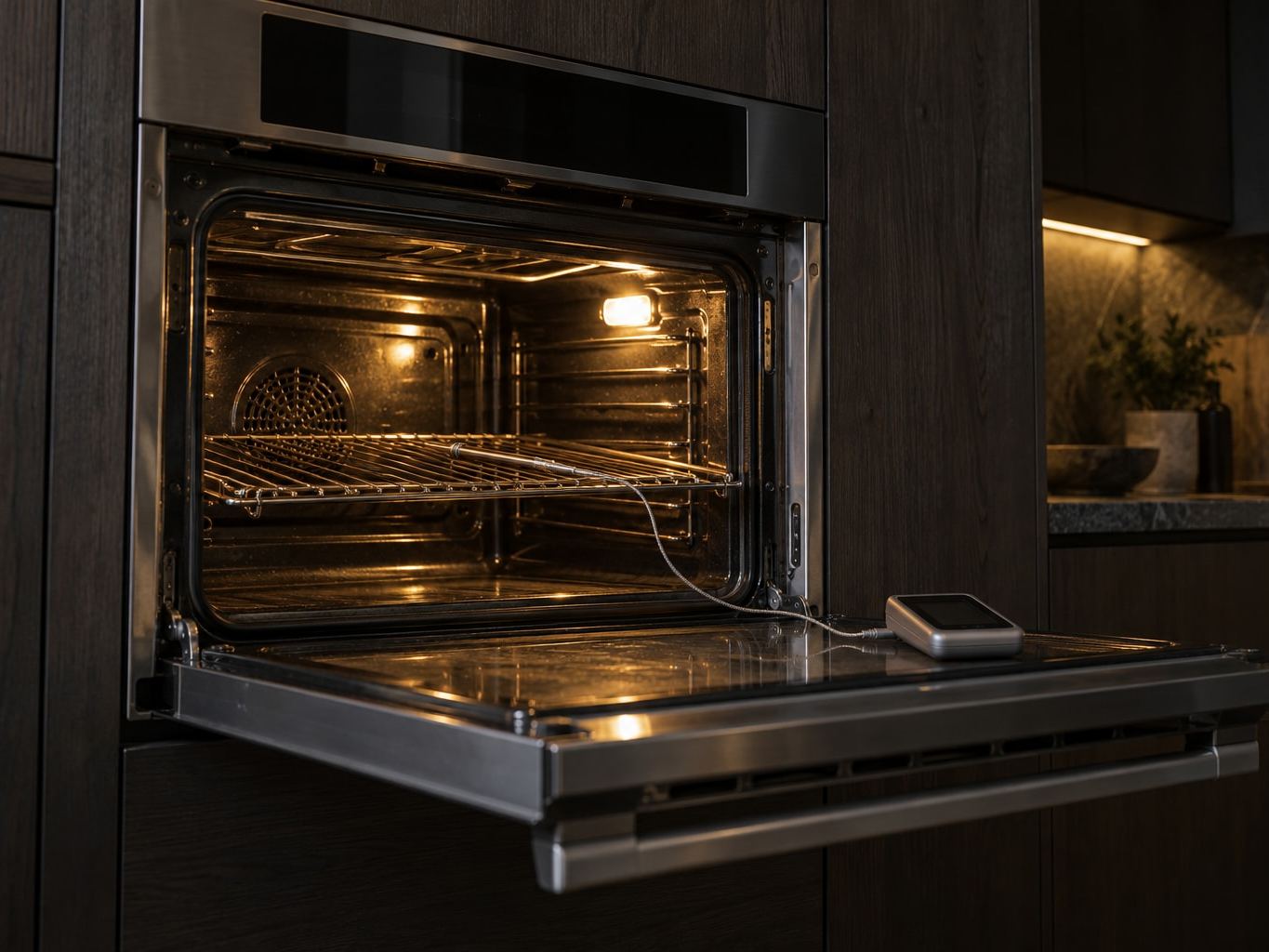
Reading the oven through your cooking
Each pattern below points somewhere specific. Note which ones you see and in which cavity.
-
Lights and display work, but the cavity barely warms
Likely cause: Open bake element, sensor reading wrong, or a relay that no longer closes
-
Food is consistently over- or under-done at the set temperature
Likely cause: Temperature sensor drift or a calibration offset in the controls
-
Convection mode heats, but the fan never spins or rattles loudly
Likely cause: Convection fan motor, a seized bearing or the fan's own element
-
Door won't close flush, or heat escapes along the edge
Likely cause: Worn gasket or hinges that have sagged
-
A code or message appears and the oven shuts down
Likely cause: Control board, a sensor out of range, or the door latch circuit
-
One side of the tray browns faster than the other
Likely cause: Weak convection airflow, a partly failed element, or a gasket letting heat out
Things owners tell us that aren't quite true
-
Often heardMy oven warms up, so its sensor can't be the problem.
In practiceA drifting sensor still allows heating. The cavity gets warm but settles at the wrong number, so recipes go off without any obvious failure.
-
Often heardAn element is either working or dead.
In practiceElements often fail gradually. Look for bubbles on the surface, a split in the sheath or dark scorched patches. A damaged element may glow in places and leave cold zones elsewhere.
-
Often heardThe convection fan is a luxury; the oven bakes without it.
In practiceOn a convection setting, the controls expect the fan to move hot air. With a dead fan the oven still heats, but browning becomes patchy and cook times stretch.
-
Often heardA stuck error code means the board is ruined.
In practiceMany codes are triggered by a sensor or latch reporting a bad value. Replacing the board without testing those first can waste money on the wrong part.
Short answerWolf convection fan not working: what causes it?
When the convection fan in a Wolf oven goes quiet, look first at a failed fan motor, a seized bearing or a fault in the circuit that powers it from the control board. A grinding or rattling sound before it stopped suggests the bearing. The oven will still heat, but convection results suffer until the motor or its supply is repaired.
Notes worth making before you call
A few minutes of watching the oven shortens the visit and helps us bring the right part.
- Which cavity is affected, if you have a double oven
- Which modes still work: bake, broil, convection, any others
- Whether the oven heats slowly, overshoots or never reaches the set point
- Any code shown on the screen, ideally photographed
- Unusual sounds: fan rattle, clicking relays, a hum with no heat
- Visible damage on the element: blisters, a break or dark spots
- When the issue began, and whether it followed a self-clean cycle
- The model label, usually printed on the frame just inside the door
Oven components we test and replace
| Component | Typical fault | How we confirm it |
|---|---|---|
| Bake and broil elements | No heat, cold zones, slow preheat | Visual check and a resistance test with a meter |
| Convection fan and motor | Fan stopped, noisy, or uneven convection results | Run test with the panel off, bearing and wiring checked |
| Temperature sensor | Food under- or over-cooked at the set temperature | Sensor resistance checked against the reading on the controls |
| Control board and relays | Codes, dead modes, oven shutting off mid-cook | Inputs and outputs traced after sensors and latch are ruled out |
| Door gasket and hinges | Heat loss, door not closing flush, soft edges on bakes | Seal inspected around the frame, hinge alignment checked |
Short answerWho repairs Wolf double ovens near me on the North Shore?
Northland Kitchen Service repairs Wolf single and double wall ovens in Lake Forest, Highland Park, Deerfield, Libertyville, Lake Bluff and Winnetka — see the areas we cover. Each cavity is tested on its own. A $89 visit comes off the repair bill, and you approve a firm quote first.
How an oven visit unfolds
-
When you call or book
We ask which cavity, which modes and any code, so common Wolf parts such as elements and sensors are already on the truck.
-
On arrival
The technician runs the oven, watches how it heats and listens to the fan before opening anything.
-
Diagnosis
Elements, sensor, fan and board are tested in turn. You hear what failed and what fixing it costs, then decide.
-
Repair
A standard job usually takes 45–90 minutes. Elements and sensors carried on the truck are typically swapped before we leave.
-
If a part must be ordered
Control boards and less common parts may need to be ordered; we return to fit them and test the oven again.
-
Before we leave
The oven is heated in each mode you use, and the result is checked against a reference thermometer.
Wall oven questions from North Shore kitchens
- Should I fix my Wolf wall oven or replace it?
- In most cases, repair it. The cavity, frame and door of a Wolf oven are built to last; what wears out are elements, sensors, gaskets and fan motors. Once it is diagnosed, you see the firm number and choose.
- My double oven has one bad cavity — do I pay twice?
- Not at all. $89 is charged per trip, never per cavity or per appliance. If you'd like the range or hood checked on the same trip, it is still one visit fee, credited toward the repair.
- Can I calibrate my Wolf oven myself?
- Some models allow a small temperature offset from the control panel. Our article on oven temperature calibration explains how to test it. A big or wandering offset means the sensor itself should be tested.
- Why did my oven stop working right after self-clean?
- A clean cycle pushes the cavity far past normal cooking heat, which can finish off a weak element, sensor or door-lock part. Tell us it happened after a clean cycle; it helps narrow the search.
- How do I book, and what does it cost to start?
- Call (773) 830-2960 or book online. A visit costs $89 and is deducted when you go ahead with the work; the full price is quoted once the oven is diagnosed. Details are on our pricing page and contact page.
Get even baking back
(773) 830-2960Tell us which cavity and which modes are acting up, and we'll come prepared. One $89 visit per trip, credited to the repair.
Book a visit