Guide
About the Wolf line
Wolf engineering, translated into repair language
Wolf cooking equipment does not break down like a builder-grade appliance, because it is not built like one. This page walks through the parts that make Wolf cooking and ventilation equipment different, which of those parts wear, and why nearly all of them can be serviced in your kitchen. Northland Kitchen Service is an independent shop that works on Wolf only, across the North Shore of Chicago.
Engineering first, showroom second
The Wolf name has been on cooking equipment since 1934, long before it showed up in residential kitchens with its familiar red knobs. That commercial lineage still shapes how the appliances are put together: heavier steel, burners meant to run hot for long stretches, ovens that move air with fans instead of relying on a single heating element, and controls designed to hold a setting rather than drift around it.
For an owner, the practical upshot is simple. A Wolf is a collection of serviceable assemblies, not a sealed box. Igniters, valves, convection fans, temperature sensors, door gaskets, control boards and blower motors are all parts that a technician can test one at a time and replace on their own. When something goes wrong, the question is almost never whether the whole appliance is finished; it is which single component stopped doing its job.
Three design choices are worth understanding before any service call: the dual-stacked sealed burner on gas tops, convection in the ovens (with two fans in the larger cavities), and induction on the electric cooktops. Each one changes how a fault looks from the outside, and each one has its own short list of wear points.
Short answerWhat is a Wolf dual-stacked sealed burner?
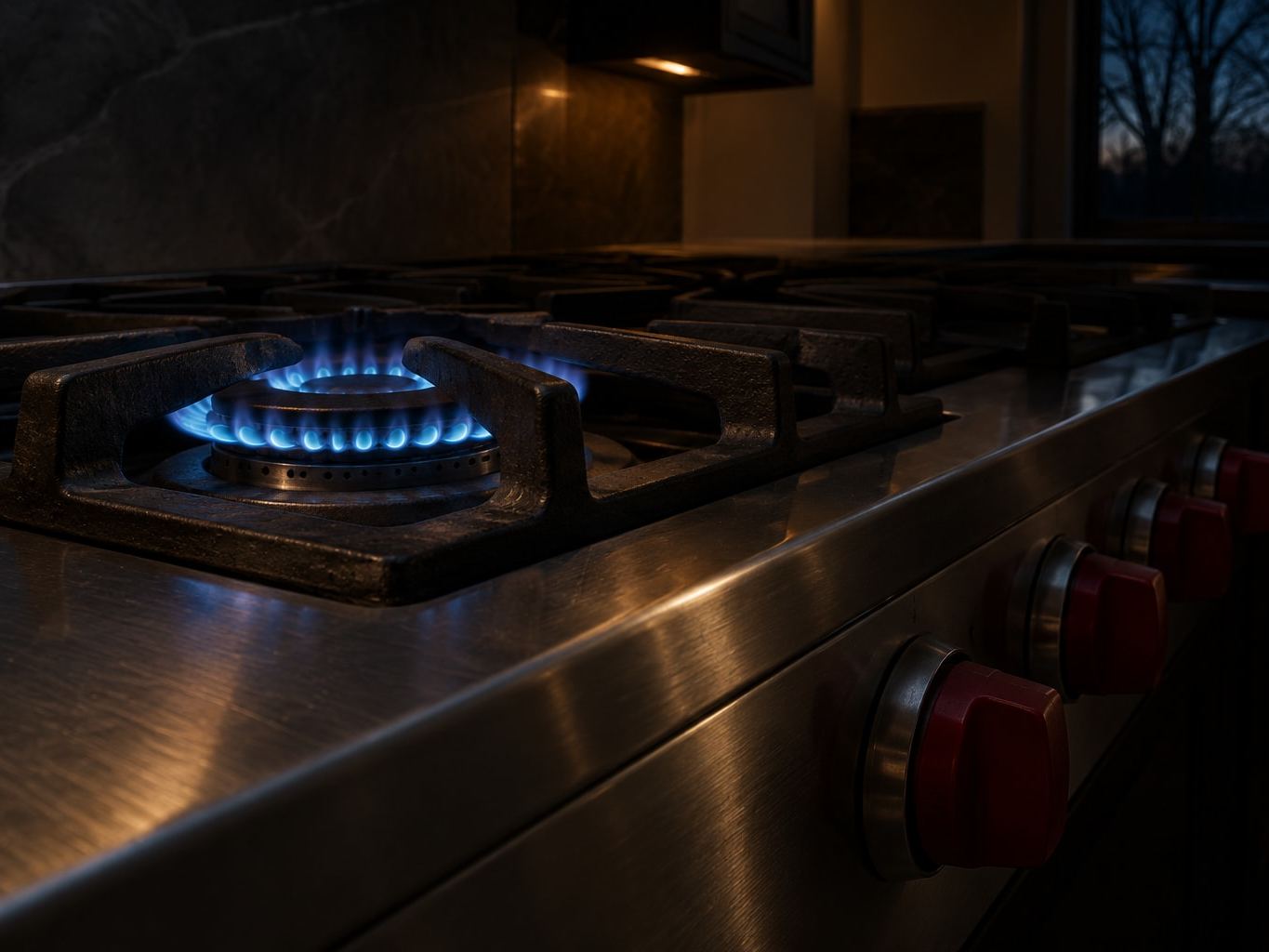
It is a gas burner with two tiers of flame ports under one cap. The upper tier delivers full heat for searing and boiling; the lower tier runs on its own at the lowest settings for a steady, gentle simmer. The burner is sealed to the cooktop, so spills stay on the surface instead of dropping into the burner box.
Each Wolf family, and where a technician looks first
Model codes vary from year to year, so we group the line by family. The middle column is the first thing tested when that family comes in with a complaint; the right column is why it tends to matter.
| Appliance family | First inspection points | Why it matters for repair |
|---|---|---|
| Ranges, gas and dual-fuel | Igniters and spark module, burner ports, oven sensor, door gasket | Two separate heat systems share one chassis, so each is diagnosed on its own |
| Wall ovens, single and double | Bake and convection elements, convection fan, temperature sensor, hinges | Uneven browning usually points to airflow, not to the control |
| Cooktops and rangetops | Gas valves and igniters, or induction power modules and glass | Gas and induction tops fail in completely different ways |
| Convection steam ovens | Water reservoir, steam generator, scale build-up, drain path | Hard water on the North Shore leaves mineral deposits that block steam |
| Microwaves and drawers | Door switches, drawer drive, magnetron, control board | Drawer models add a motorized door that needs its own check |
| Ventilation hoods | Blower motor, speed control, filters, lift on downdraft units | A tired blower lets heat and grease settle on the rest of the kitchen |
| Outdoor grills | Burner tubes, igniters, gas connections, grease management | Lake County winters punish anything left uncovered outdoors |
| Built-in coffee systems | Brew unit, grinder, milk circuit, descaling state | Most faults trace back to scale or a brew group overdue for cleaning |
Gas range or dual-fuel: two machines under one cooktop
Wolf sells ranges with gas on top and either a gas oven or an electric oven below. It is easy not to know which one you have, and the difference changes the diagnosis.
All-gas range
- Burners and oven both run on gas, each with its own valve and ignition path
- An oven that will not light is usually an igniter or gas-control question
- Any whiff of gas around the oven door is a safety call before it is a repair call
- Burner trouble and oven trouble can share a cause, such as a supply problem
Dual-fuel range
- Gas burners on top, an electric convection oven underneath
- The two halves are independent: a dead oven says nothing about the burners
- Oven faults lead to elements, fans, sensors or the control board
- Burner faults lead to igniters, ports or valves, exactly as on a gas top
Tell us which kind you own when you call. If you are not sure, a photo of the oven interior and the control panel settles it in seconds.
Short answerIs Wolf owned by the same company as Sub-Zero?
They share a parent: Sub-Zero Group owns both names, with the Wolf side making the cooking and ventilation products and the Sub-Zero side making cold storage. Northland Kitchen Service belongs to neither, and our technicians handle only the Wolf side, so a Sub-Zero unit needs a different service provider.
What owners assume, and what we actually find
-
Often heardA Wolf lasts forever, so it never needs looking at.
In practiceThe line is built for a long service life, but long life comes from upkeep: clean burner ports, a sealing oven door, a descaled steam generator. Neglected small faults are what shorten it.
-
Often heardEndless clicking at a burner means the igniter has died.
In practiceOften the igniter is fine and the problem is moisture after a boil-over, a cap that sits slightly off center, or ports clogged with residue. That is a quicker fix than a new part.
-
Often heardIf the oven quits, the whole range has to go.
In practiceWith dual-fuel, the electric oven and the gas burners run as separate systems. On any Wolf, an oven that stops heating usually comes down to one element, sensor or board.
-
Often heardA cracked induction top means buying a new cooktop.
In practiceThe glass is a replaceable part. Leave the cooktop off until the glass is swapped, because liquid can reach the electronics underneath through the crack.
How this shapes a service visit
Because each assembly can be checked by itself, a good Wolf diagnosis is a process of elimination rather than guesswork. On a gas top the technician watches the spark, the flame on both tiers and the way the valve responds through its range. On a convection oven the checks cover the element, the fan and the sensor reading against a reference thermometer. On induction the work moves to the power electronics and the cooling fan that keeps them alive. When an oven is calibrated, it is checked against a reference thermometer and set back to the temperature shown on the dial, not to a rough approximation.
The service call is $89 per trip, and it covers every Wolf appliance the technician looks at during that visit, whether that is one oven or a range, a hood and a steam oven together. Once you say yes to the repair, that fee is credited against it. You hear the exact price after the technician has looked things over and before a single part is touched, so nothing gets fixed on assumption.
We repair Wolf equipment of any age, including units long past their factory coverage. For owners who want fewer surprises, a yearly visit for cleaning, calibration and a look at the wear points can be booked like any ordinary appointment. There is no separate plan to sign; it is simply a regular appointment.
Short answerHow many years do Wolf appliances typically last?
Wolf builds its cooking line for a long working life, and many units stay in service for a very long time when they are maintained. Real lifespan depends on how hard the appliance works, how clean it is kept, local water hardness for steam and coffee models, and how quickly small faults get repaired instead of ignored.
Questions about the Wolf line
- Do you repair every type of Wolf appliance?
- Everything Wolf makes for cooking and moving kitchen air is in scope: freestanding and dual-fuel ranges, single and double wall ovens, gas and induction tops, rangetops, steam ovens, microwave drawers and built-in microwaves, hoods and downdraft units, outdoor grills, and the built-in coffee machine. New installations and cold storage are outside what we do.
- My Wolf range is old and out of factory coverage. Can it still be repaired?
- Yes. We take Wolf units of every vintage. Older ones are made of the same kind of replaceable assemblies, and after the inspection you get a straight opinion on whether the fix is worth it.
- Why does my Wolf oven have two fans when my old oven had none?
- Convection uses a fan to move heated air around the cavity so food cooks evenly on every rack. Larger Wolf ovens use two fans for the same reason. When one fan slows or stops, you usually notice uneven browning before anything else.
- Are Wolf induction tops tougher to fix than gas tops?
- Not tougher, just a different kind of job. Gas tops mostly need attention at the igniters, ports and valves. Induction tops shift the work to power modules, sensors, cooling fans and the glass. Both are repaired in the home.
- Are you connected to Wolf or Sub-Zero Group?
- No. Northland Kitchen Service runs on its own, with no tie to Wolf Appliance or Sub-Zero Group and no endorsement from either. Their trademarks stay theirs; we mention the names only so you know which equipment we service.
Next stops on this site
If you already know which appliance is acting up, the service pages go deeper into symptoms and causes.
- All Wolf services
The full list of appliance families we repair, in one place.
- Range repair
Silent or clicking burners, ovens drifting off temperature, dual-fuel quirks.
- Cooktop repair
Gas, induction and electric tops, each with its own failure pattern.
- Steam oven repair
Scale, missing steam, water that will not drain.
- Gas or induction?
How the two cooktop types differ in daily use and in repair.
- About Northland
The people behind the shop and the reason it sticks to one brand.
Something on your Wolf not behaving?
(773) 830-2960Phone (773) 830-2960 at any time of day, or pick a slot through the booking window. House calls run every day, 8 AM to 6 PM; the $89 trip fee covers every Wolf appliance checked that visit.
Book a visit